|
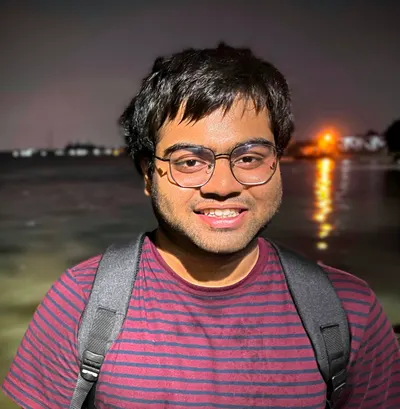
Anindya Mondal, PhD I recently received my Ph.D. in Artificial Intelligence from the CVSSP (University of Surrey), where I was advised by Dr. Anjan Dutta, Dr. Xiatian Zhu, and Dr. Joaquin M. Prada, while working closely with Dr. Sauradip Nag. Currently I am also working as a Research Scientist Intern at Adobe Research. My work tackles compositional hallucinations via RL post-training (GRPO, criterion-level PRMs), inference-time compute allocation (agentic planner-critic loops), and semantic-geometric grounding. I have authored 7+ papers in premier venues (ACM TOG, AAAI, ICCV) and actively mentor graduate researchers in computer vision. |
|
| 🚀 Looking for Opportunities: I am actively looking for Postdoctoral Associate or Research Scientist positions in generative modeling, agentic systems, and multimodal understanding areas. Please feel free to reach out here. |
News
|
Work Experience |

|
Adobe Research, Bengaluru, India Position : Research Intern Building rubric-aware VLM judges (reward models) to evaluate generated content. Jun 2026 - Present |

|
University of Surrey (CVSSP), Guildford, UK Position : Doctoral Researcher Research on unified vision-language models, generative AI, and RL post-training. Oct 2022 - Oct 2026 |

|
Indian Institute of Science, Bengaluru, India Position : Research Intern Developed a source-free domain-adaptation framework for image classification. May 2022 - Aug 2022 |

|
Jadavpur University, Kolkata, India Position : Undergraduate Research Assistant Graph learning and event-based vision for signal recovery and moving-object detection. Oct 2020 - May 2022 |
ResearchMy research interests include computer vision, generative AI, and vision-language models. Some papers are highlighted. |
|
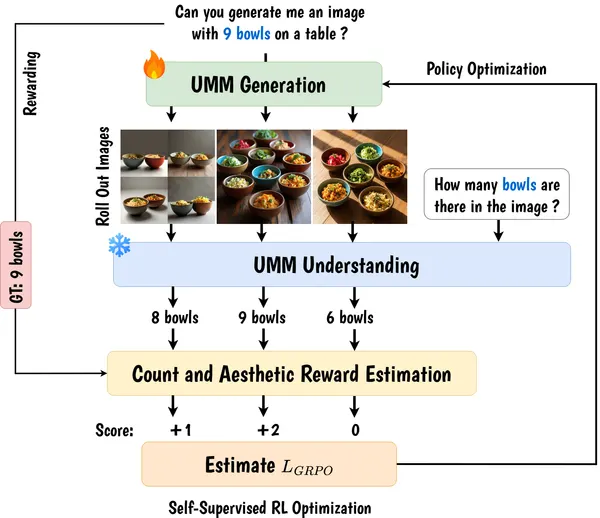
ABACUS: Adapting Unified Foundation Model for Bridging Image Count Understanding and Generation
Anindya Mondal, Sauradip Nag, Anjan Dutta ACM Transactions on Graphics/ SIGGRAPH ASIA, 2026 PDF / arXiv / web TL;DR▼Single unified 3B-parameter VLM that jointly solves object counting, crowd counting, referring-expression counting, and count-faithful image generation via density-aware adaptive zooming, MLLM attention-derived objectness maps, and a cycle-consistent GRPO strategy with nested local, boundary, and global rewards, achieving state-of-the-art across seven benchmarks without any benchmark-specific training. |
|
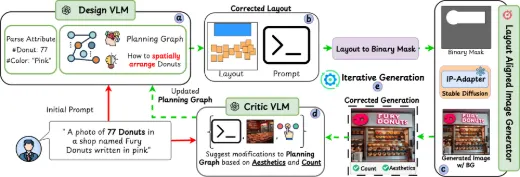
CountLoop: Iterative Agent Guided High Instance Image Generation
Anindya Mondal, Ayan Banerjee, Sauradip Nag, Josep Llados, Xiatian Zhu, Anjan Dutta TMLR, 2026 PDF / arxiv / web TL;DR▼Training-free diffusion pipeline with a VLM planner–critic loop: the planner generates structured instance layouts via chain-of-thought reasoning; the critic provides count and spatial feedback; instance-driven cross-attention masking with cumulative attention composition prevents semantic leakage across high-density scenes, reducing counting error by up to 57%. |
|
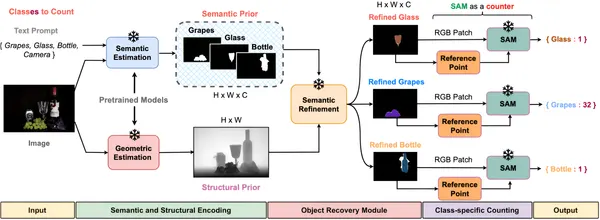
OmniCount: Multi-label Object Counting with Semantic-Geometric Priors
Anindya Mondal, Sauradip Nag, Xiatian Zhu, Anjan Dutta AAAI, 2025 DOI / arXiv / web TL;DR▼Training-free multi-label counter coupling CLIP semantic embeddings for open-vocabulary category grounding with SAM point-prompt geometric priors for precise instance segmentation; introduces OmniCount-191, the first benchmark with point, bounding-box, and VQA multi-label count annotations. |
|
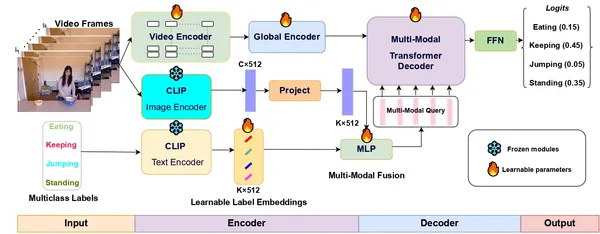
Actor-agnostic Multi-label Action Recognition with Multi-modal Query
Anindya Mondal, Sauradip Nag, Joaquin M. Prada, Xiatian Zhu, Anjan Dutta ICCVW, 2023 DOI / code / web TL;DR▼Transformer decoder treating each action class as a multi-modal semantic query (CLIP visual + text embeddings), decoupling action classification from actor-specific pose topology for actor-agnostic multi-label recognition; state-of-the-art across five benchmarks spanning human and animal actions. |
|
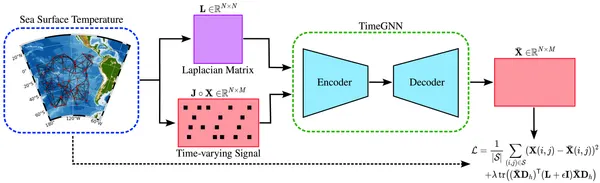
Time-varying Signals Recovery via Graph Neural Networks
John A. Castro-Correa, Jhony H. Giraldo, Anindya Mondal, Mohsen Badiey, Thierry Bouwmans, Fragkiskos D. Malliaros ICASSP, 2023 PDF / DOI TL;DR▼Encoder-decoder GNN (TimeGNN) trained with a composite loss of MSE and a Sobolev graph smoothness operator, exploiting spatio-temporal correlations across graph topology for robust missing-entry recovery on real sensor and traffic datasets. |
|
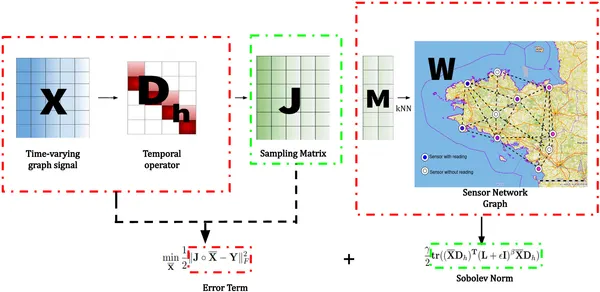
Recovery of Missing Sensor Data by Reconstructing Time-varying Graph Signals
Anindya Mondal, Mayukhmali Das, Aditi Chatterjee, Palaniandavar Venkateswaran EUSIPCO, 2022 PDF / DOI / code TL;DR▼Formulates missing wireless sensor data recovery as time-varying graph signal reconstruction minimising a Sobolev norm combining graph Laplacian smoothness across spatial and temporal dimensions, surpassing state-of-the-art by up to 54% at high missing-data rates. |
|
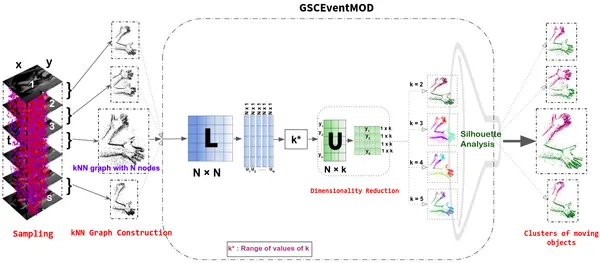
Moving Object Detection for Event-based Vision using Graph Spectral Clustering
Anindya Mondal, Shashant R, Jhony H. Giraldo, Thierry Bouwmans, Ananda S. Chowdhury ICCVW, 2021 PDF / DOI / code TL;DR▼Maps asynchronous event streams to a k-NN graph, applies graph Laplacian spectral decomposition for eigenvector-based clustering (GSCEventMOD), and determines the optimal cluster count via spectral gap analysis, enabling fully unsupervised moving object detection for event cameras. |
Education |
|
|
University of Surrey, United Kingdom Position : Doctor of Philosophy (Ph.D.) in Artificial Intelligence Thesis: Integrating Auxiliary Information for Visual Scene Understanding and Generation Oct 2022 - Oct 2026 |
|
|
Jadavpur University, Kolkata, India Position : Bachelor of Engineering (B.E. Hons.) in Electronics & Telecom Thesis: Graph Signal Processing and Event-based Vision Aug 2018 - May 2022 |
MiscellaneaAcademic Service
Teaching & Mentorship [Teaching Reference Letter]
|
|
Template from Jon Barron. |